
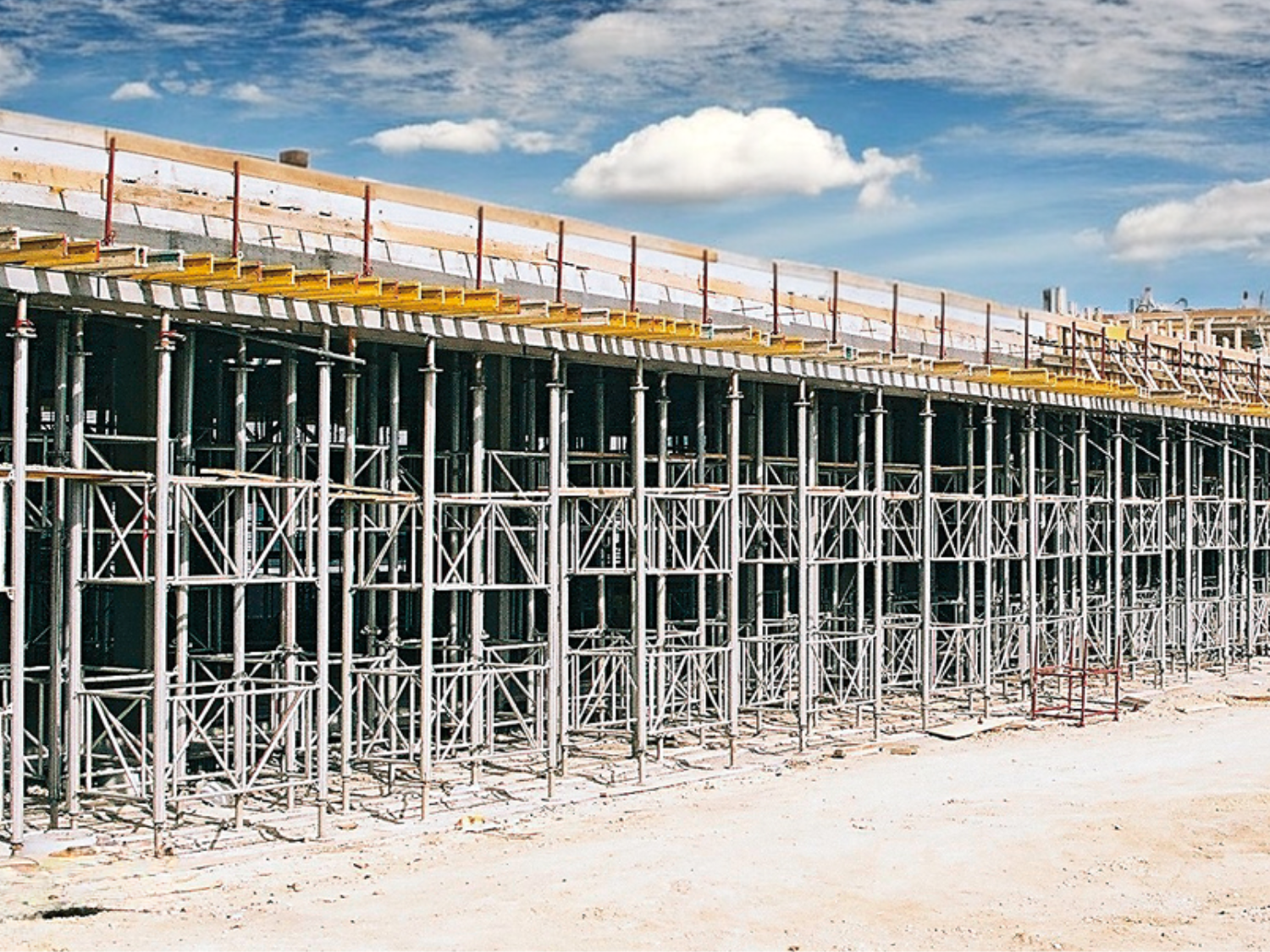
Formwork and shoring systems are temporary elements, but fundamental in the execution process of cast-in-place concrete structures in civil construction. They are responsible for shaping the final geometry of structural components (formwork) and supporting the weight of fresh concrete, reinforcement, and construction loads (shoring), ensuring that the elements achieve the required strength without excessive deformations or collapses.
In Brazil, the guidelines and technical requirements for the design, dimensioning, and execution procedures of these systems are established by the official standard of the Brazilian Association of Technical Standards (ABNT), specifically NBR 15696:2009 – Formwork and shoring for concrete structures – Design, dimensioning, and execution procedures.
NBR 15696 establishes the minimum requirements to ensure the safety, quality, and performance of these temporary structures.
1. Design and Dimensioning
Acting Loads: The self-weight of the formwork and shoring, the weight of fresh concrete and reinforcement, as well as minimum construction loads and wind action, must be considered.
Fluid Concrete Pressure: Specific calculation criteria for vertical formwork are defined in Annex D of the standard, taking into account the concrete placement rate and height, vibration, and other factors.
Limit States: The design must ensure safety against ultimate limit states (failure or collapse) and serviceability limit states (deformation limits).
2. Execution Procedures and Safety
Assembly: It requires the use of industrialized equipment in accordance with the supplier’s instructions, proper design of the support bases, and the mandatory preparation of a design.
Stripping and Reshoring: The removal of formwork and shoring may only occur when the concrete has achieved sufficient strength to withstand the applied loads. NBR 14931 (Execution of Concrete Structures) and NBR 15696 (Annex C) establish time and strength criteria, with a minimum period of 14 days often set for the removal or relocation of shoring, depending on the type of structure and the concrete strength. For multi-story structures, the use of reshoring and/or retained props is regulated to ensure that the loads from upper floors and construction activities are properly distributed to the lower slabs.
In large-scale projects, the choice of formwork and shoring systems is a determining factor for productivity, cost, and final quality. In these projects, the most common and efficient solution is the use of high-performance industrialized systems, replacing in-situ timber formwork, which, although common, may be more prone to errors and require greater labor and execution time.
Common Types in Large-Scale Projects
Modular Metal Formwork: Used for columns, walls, and slabs, composed of steel or aluminum panels that allow for rapid assembly and disassembly, essential for the accelerated cycle of large-scale construction.
Escoramento Metálico: Escoras tubulares, torres de carga e sistemas modulares que suportam grandes pesos e pé-direito elevado com alta segurança e durabilidade.
Slipform or Climbing Formwork: Essential for tall vertical structures (towers, silos), as they move vertically as the concrete hardens, optimizing continuous concreting.
The selection of the most suitable system must take into account factors such as on-site logistics, the number of reuse cycles, the loads to be supported, and the dimensions of the structures to be formed, always based on the strict safety and design specifications of NBR 15696. Learn about Stecla Engenharia’s construction planning and management services and discover how we reduce waste, optimize processes, and promote safe work environments.

 English
  Português do Brasil
  Español