
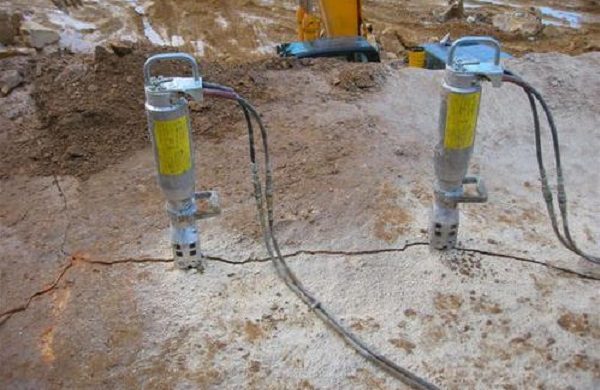
The Expansive Darda, also known as the Hydraulic Darda, is one of the safest and most efficient methods for breaking rock and concrete. Unlike methods that rely on explosive force or chemical reactions, the hydraulic Darda operates through a controlled hydraulic wedge system. The process begins with drilling holes into the material to be dismantled—whether compact rock or reinforced concrete. Next, a set of interconnected wedges, activated by a high-pressure hydraulic system, is inserted into these holes.
Once activated, the hydraulic pump exerts a monumental pressure that can easily exceed 400 tons. This force is directed toward the internal walls of the holes, causing the wedge to advance and expand, generating internal tension within the material. This tension results in a clean and precise fracture, without the need for explosions or chemical agents. It is as if the material were carefully “split” from the inside out, ensuring full control over the dismantling process.
Advantages of the Expansive Darda
The expansive darda offers multiple advantages when compared to traditional methods:
Expanded safety: The elimination of explosives removes inherent risks such as accidental detonations, flying debris, and the release of toxic gases. This creates a safer construction site for workers and for adjacent structures.
Reduced Environmental Impact: Without explosions, there is no emission of atmospheric pollutants or hazardous waste. In addition, the absence of excessive noise and vibrations minimizes the impact on urban areas or sensitive ecosystems, making it easier to obtain environmental permits and comply with strict regulations.
Precise Control of Demolition: The ability to fracture the material in a controlled manner enables surgical demolition, ideal for complex projects in which the integrity of nearby structures is critical. This prevents collateral damage and reduces the need for subsequent repairs.
Optimization of Costs and Schedules: Although the initial investment may be considered, the long-term benefits are significant. The elimination of permits for explosives streamlines the planning phase. The reduced need to isolate large areas and the lower costs associated with specialized explosive labor (blasters) or the removal of pulverized debris have a positive impact on the budget. In addition, the speed of the process and the reduction of operational interruptions directly contribute to meeting deadlines.
Operational Versatility: The expansion darda is particularly valuable in scenarios where other methods are unfeasible:
- Dense Urban Areas: Demolition of old foundations, rocks for basement excavation, or street widening without disturbing traffic or nearby residences.
- Confined Spaces: Construction or widening of tunnels, galleries, and shafts in locations with limited ventilation or restricted access.
- Underwater Projects: Demolition of underwater structures or rock breaking for dredging ports and channels.
- Near sensitive structures: Work near hospitals, historic buildings, or critical infrastructure (gas pipelines, electrical networks) where vibrations are prohibited.

 English
  Português do Brasil
  Español